Having an optimal Batch size can decrease your models cost per token at the time of inference.
This will be an explanation on how Batch size affects the cost at the inference, We will be going deep and building the framework from the ground up. This will be an informal explanation of the concept so don’t expect any formal language.
The word plot and graph are used interchangebly in this Article so dont get confused
Shall we begin this journey my square.

Dependencies
So first thing we need to understand is what does LLM inference actually depends upon.

In the equation above we can see that the actual time taken to do inference depends on two major factors
1 -> Memory
KV cache & Model weights fetching time
2 -> Compute
The time it takes to perform mathematical operations
The equation says, The time it takes to do inference is greater than or equal to the max value between time it takes for compute and time it takes to fetch the memory.
Time taken to fetch the memory ($t_{memory}$)
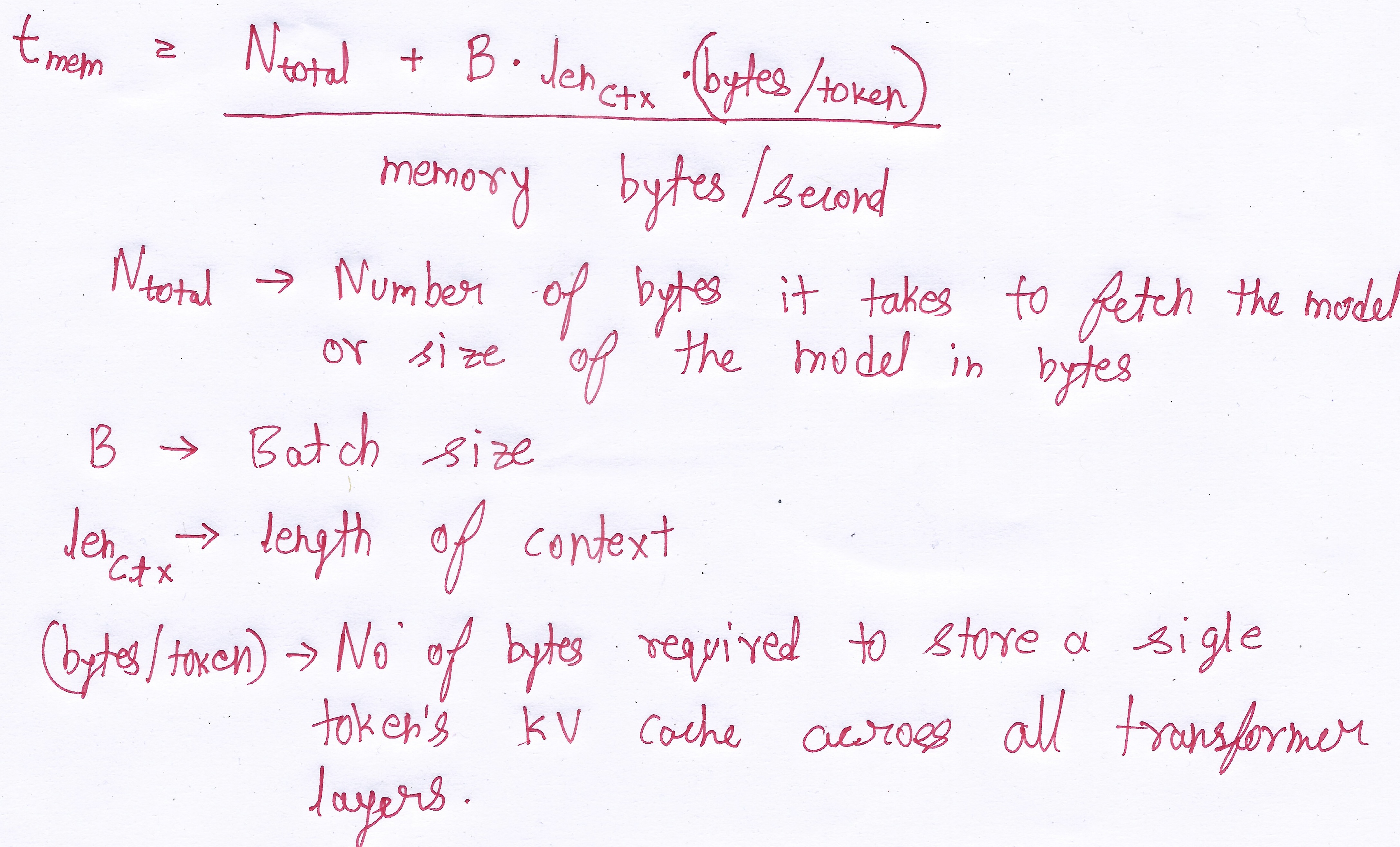
In the equation above, time taken to fetch the memory is the sum of size of the model in bytes and the kv cache in bytes divided by the memory bandwidth
here the kv cache is
$B \cdot \text{len}_{\mathrm{ctx}} \cdot \left(\frac{\text{bytes}}{\text{token}}\right)$
Time taken for compute ($t_{compute}$)
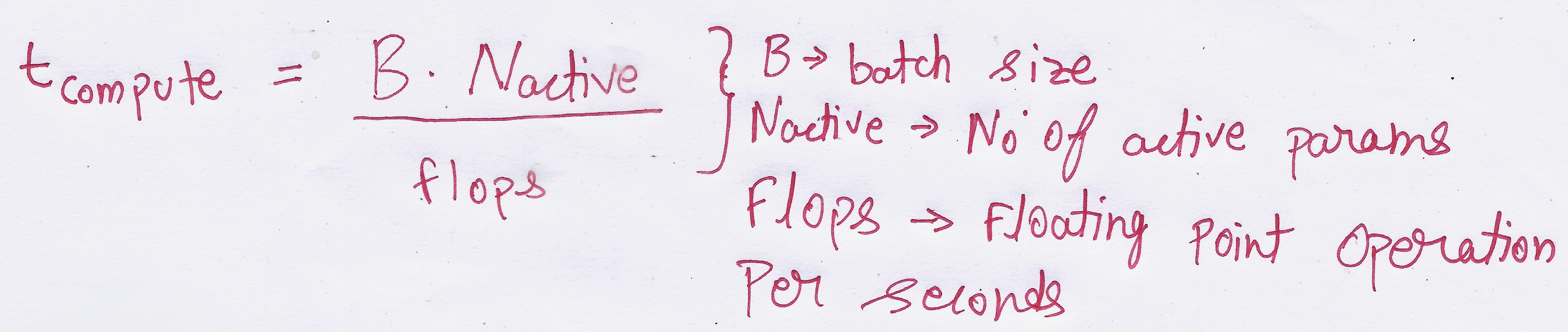 The equation $t_{compute}$ is batch size multiplied by number of active parameter divided by flops
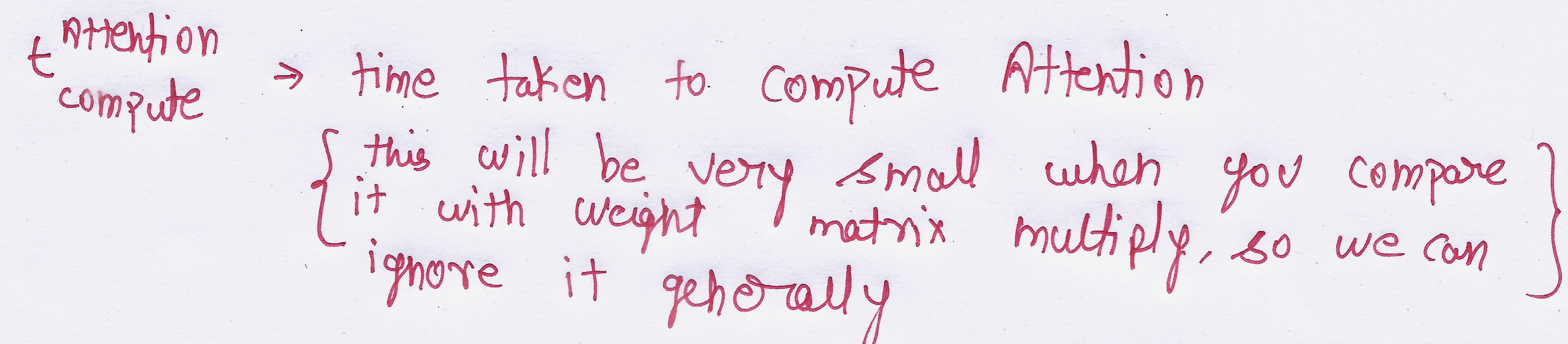
We don’t take time it takes to do the attention computation into account because its trivial when you compare it with the weight matrix multiplication cost.
Plotting the graphs
What we have here is the latency plot, we are essentially plotting all the values that we worked with earlier, on this graph.
plot 1.1
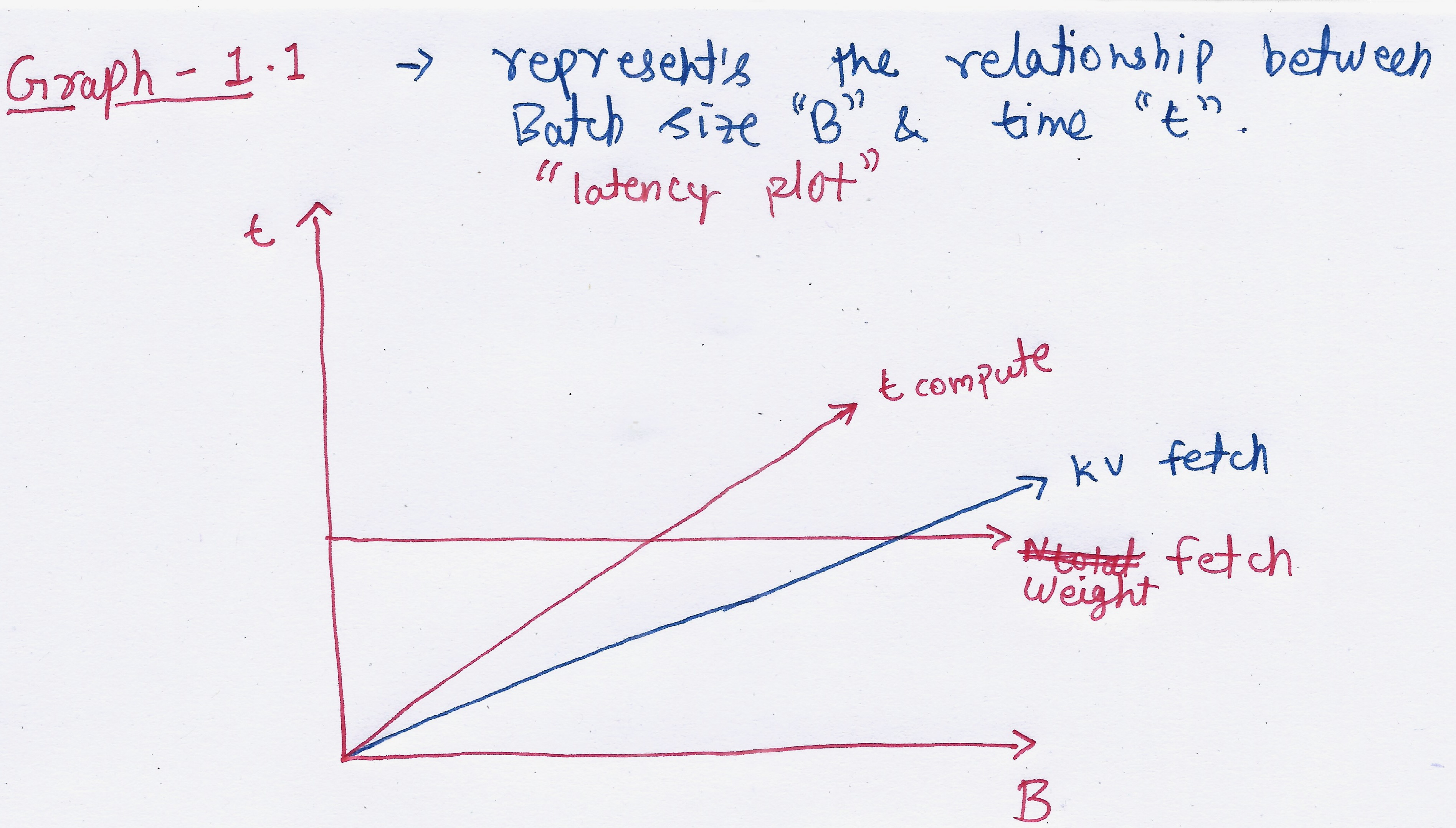
- $t_{compute}$ grows linearly as the batch size increases
- $t_{kv-fetch }$ also grows linear.
- $t_{weight-fetch}$ dosen’t grow at all it remains constant
plot 1.2
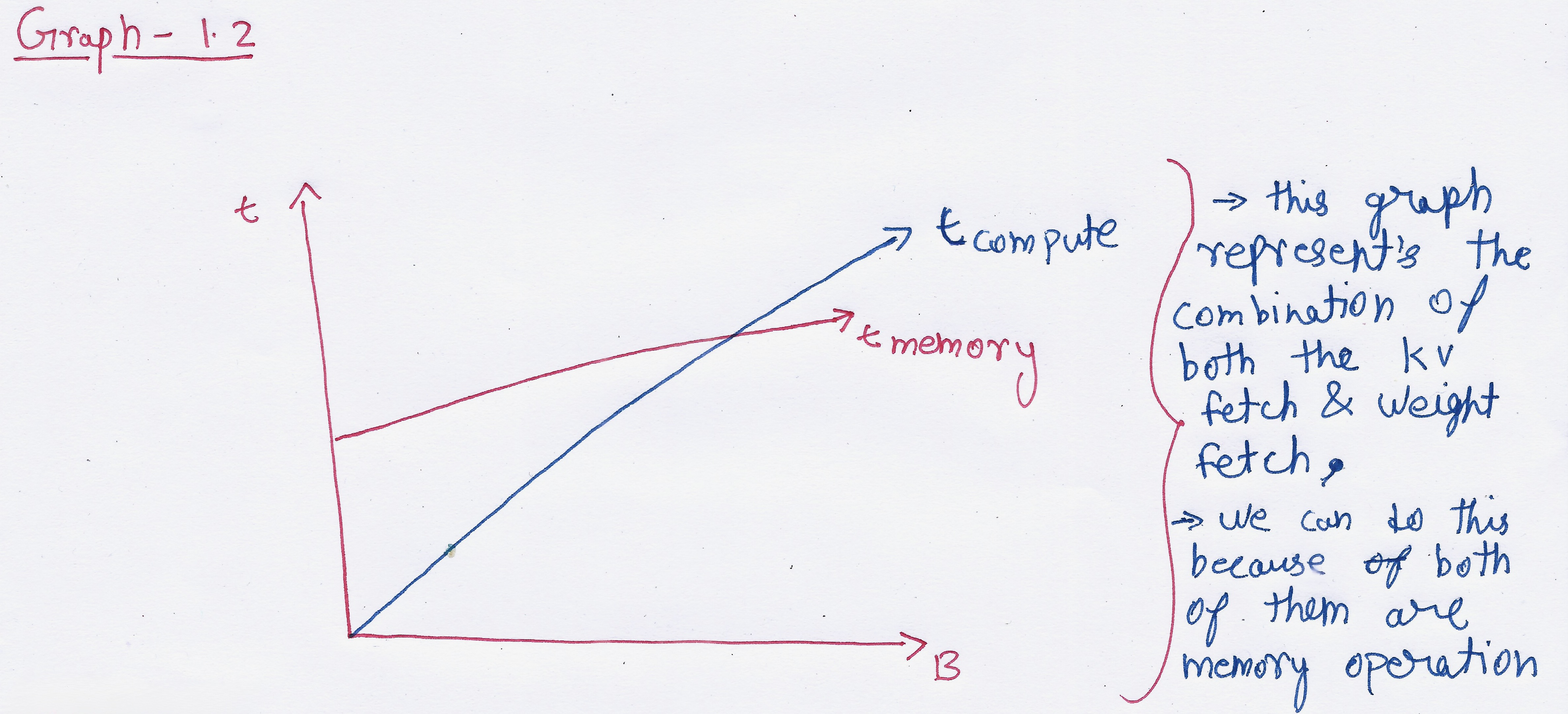
- plotting the conjunction of both $t_{weight-fetch }$ & $t_{kv-fetch }$ as $t_{memory}$
- notice that the y intercept of $t_{memory}$ starts exactly from the $t_{weight-fetch }$ intercept
plot 1.3
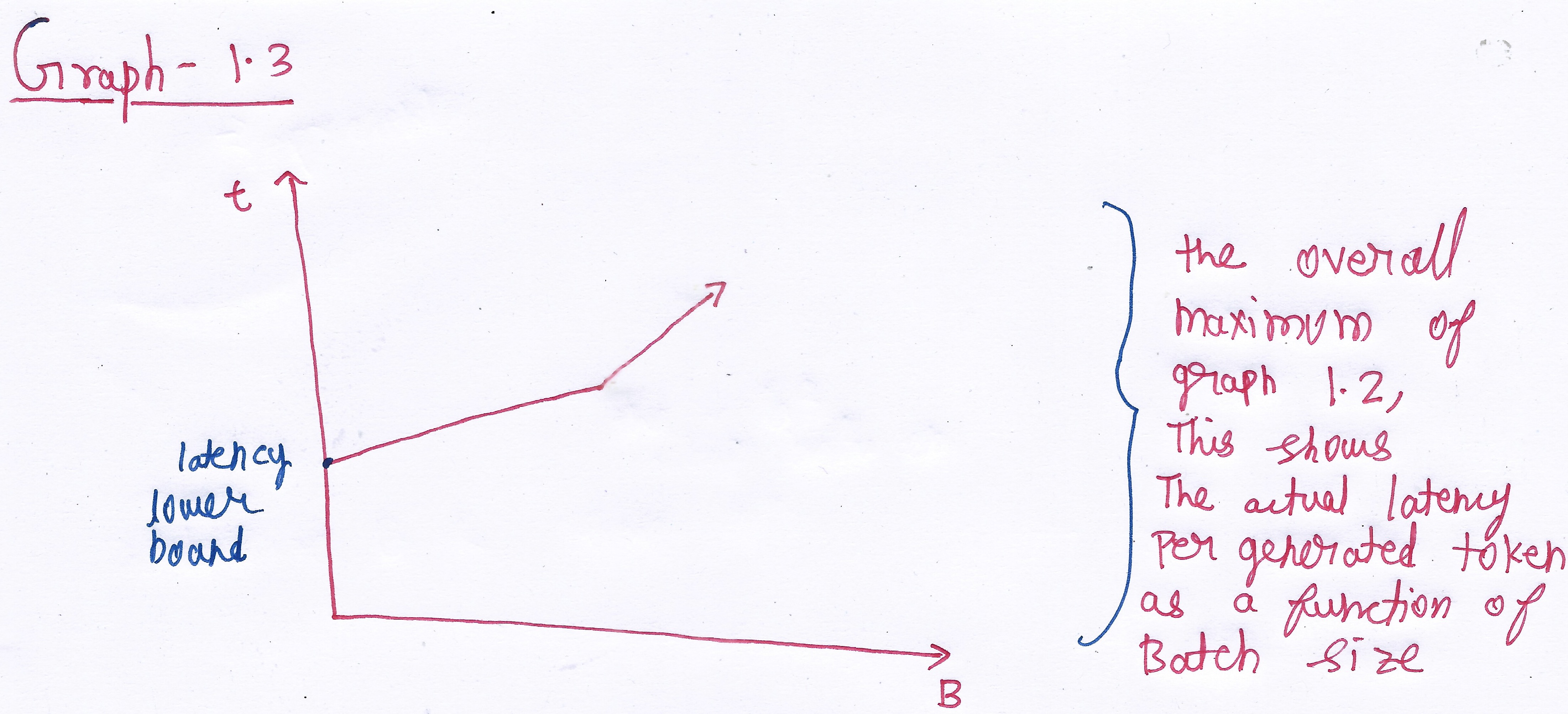
- Here we are taking the maximum of $t_{compute}$ & $t_{memory}$
- Now this graph tells us, How latency grows with the increase in batch size.
- The point worth noting here is that there is a lower bound on latency, because the time it takes to load the model parameters is a constant
we have been plotting the latency (t) as the function of batch size, but to get cost per token we need to plot (t/B) cost as the function of batch size.
plot 2.1
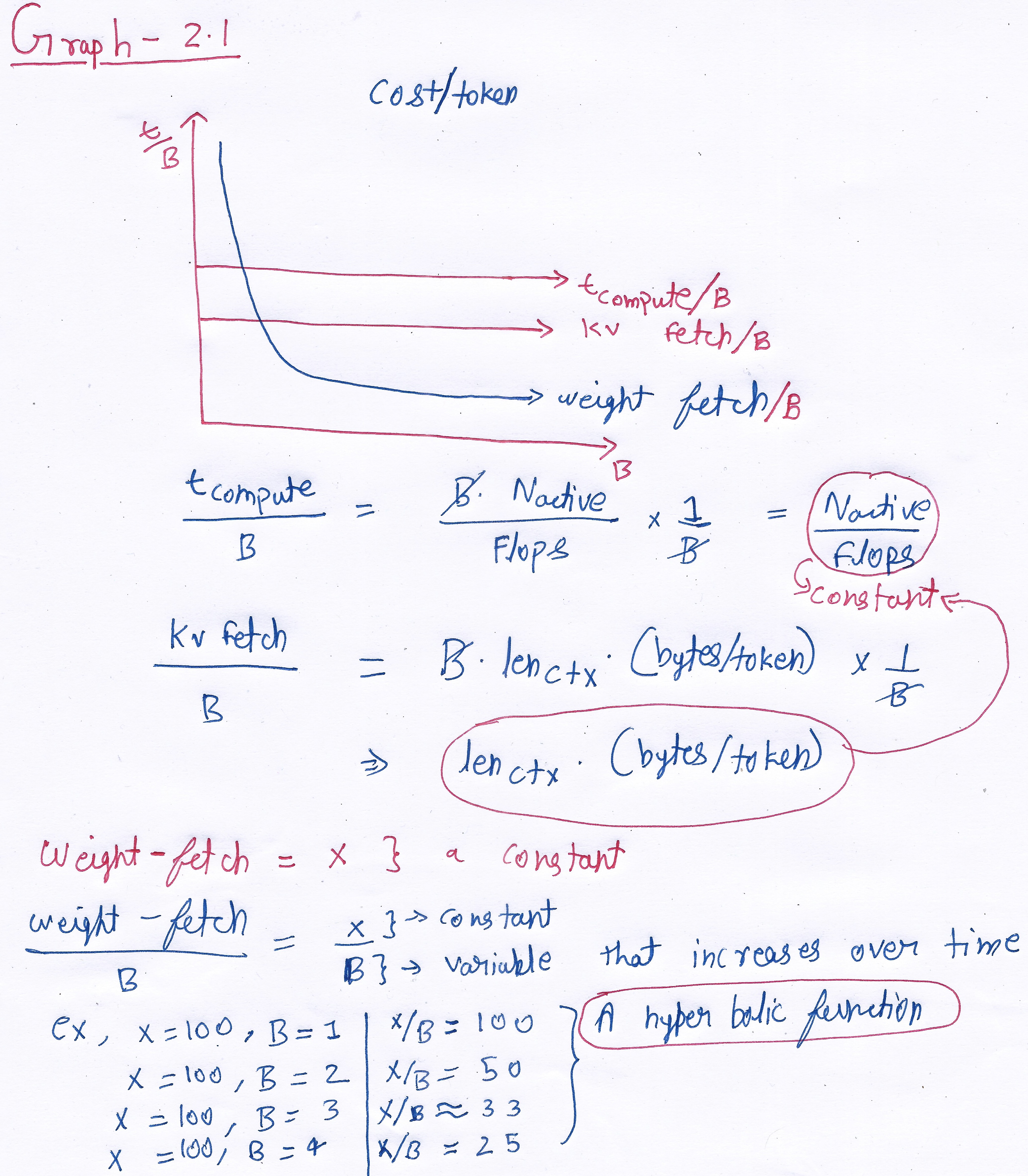
The Graph 2.1 plots (t/B) as a function of (B), and the variables change quite a bit
- $t_{compute}$ was linear but after dividing it by (B) we get a constant
- $t_{KV-fetch}$ was also linear but after dividing it by (B) we get a constant
- $t_{weight-fetch}$ was constant but after dividing it by (B) we get a hyperbolic curve
plot 2.2
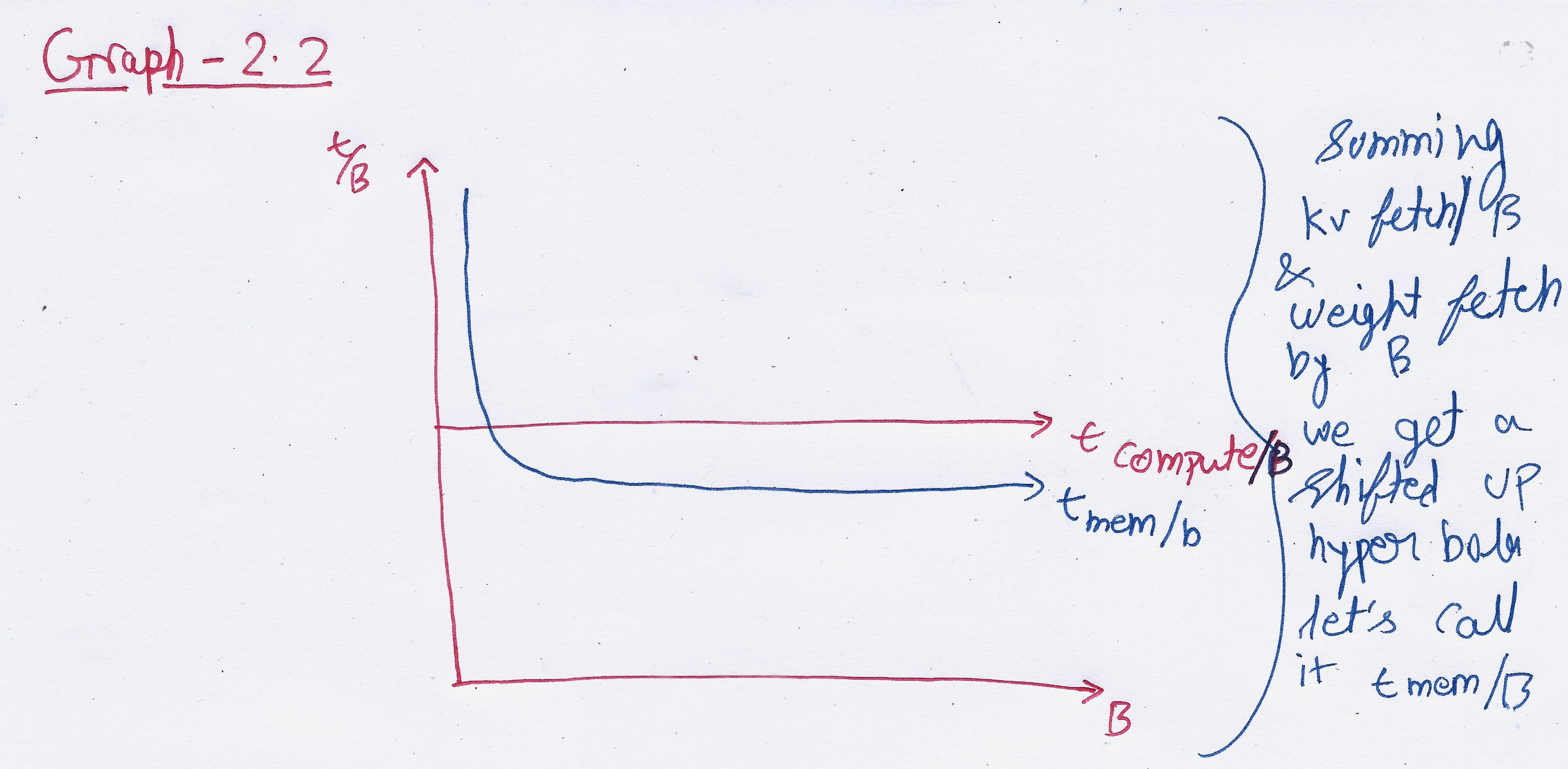
- Plotting the conjuntion of both $t_{weight-fetch }$ & $t_{kv-fetch }$ as $t_{memory}$
- What happens is that the conjuntion shifts the hyperbola up
plot 2.3
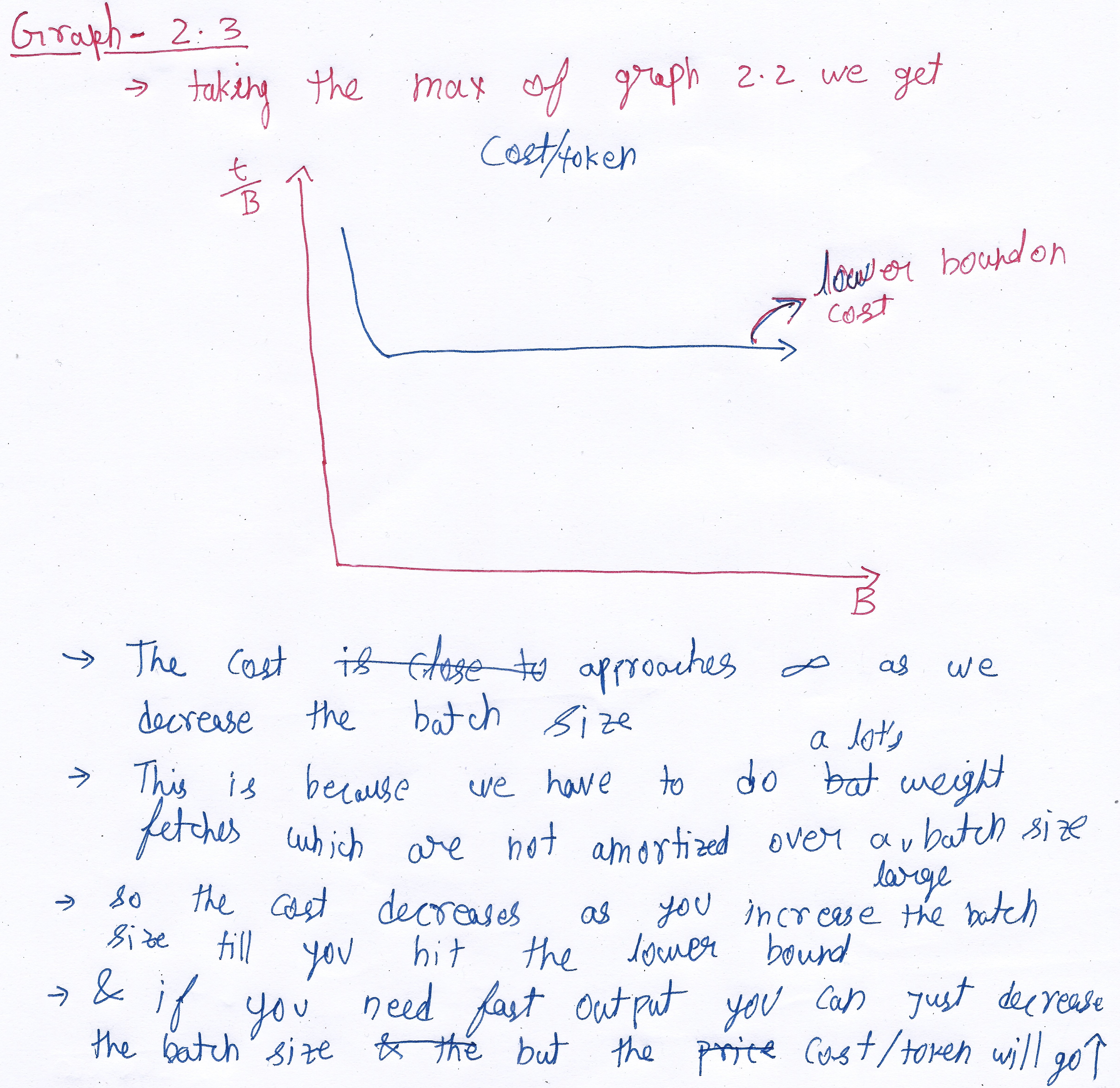
- Taking the maximum of the graph 2.2 we get graph 2.3
- Now, you can see the cost per token plot
Observations
- In the graph 2.3 you can see that the cost decreases as we increase the batch size until it hits the lower bound
- If you want you can do a cost and inference time tradeoff where as you decrease the batch size the cost goes up but inference time decreases
- There is a lower bound on cost too which is $t_{compute}$.
- Here is a caveat, As you increase the batch size, at some point $t_{kv-fetch }$ will surpass $t_{compute}$ and at that point compute is no longer the lower bound its memory bandwidth and the MFU (model flop utilization) decreases significantly, So the cost/token increases if the batch size is too big
Thanks for the read :)
I wrote this article because its the most pedagogically effective way for me to understand this topic explained by Reiner Pope on Dwarkesh patel